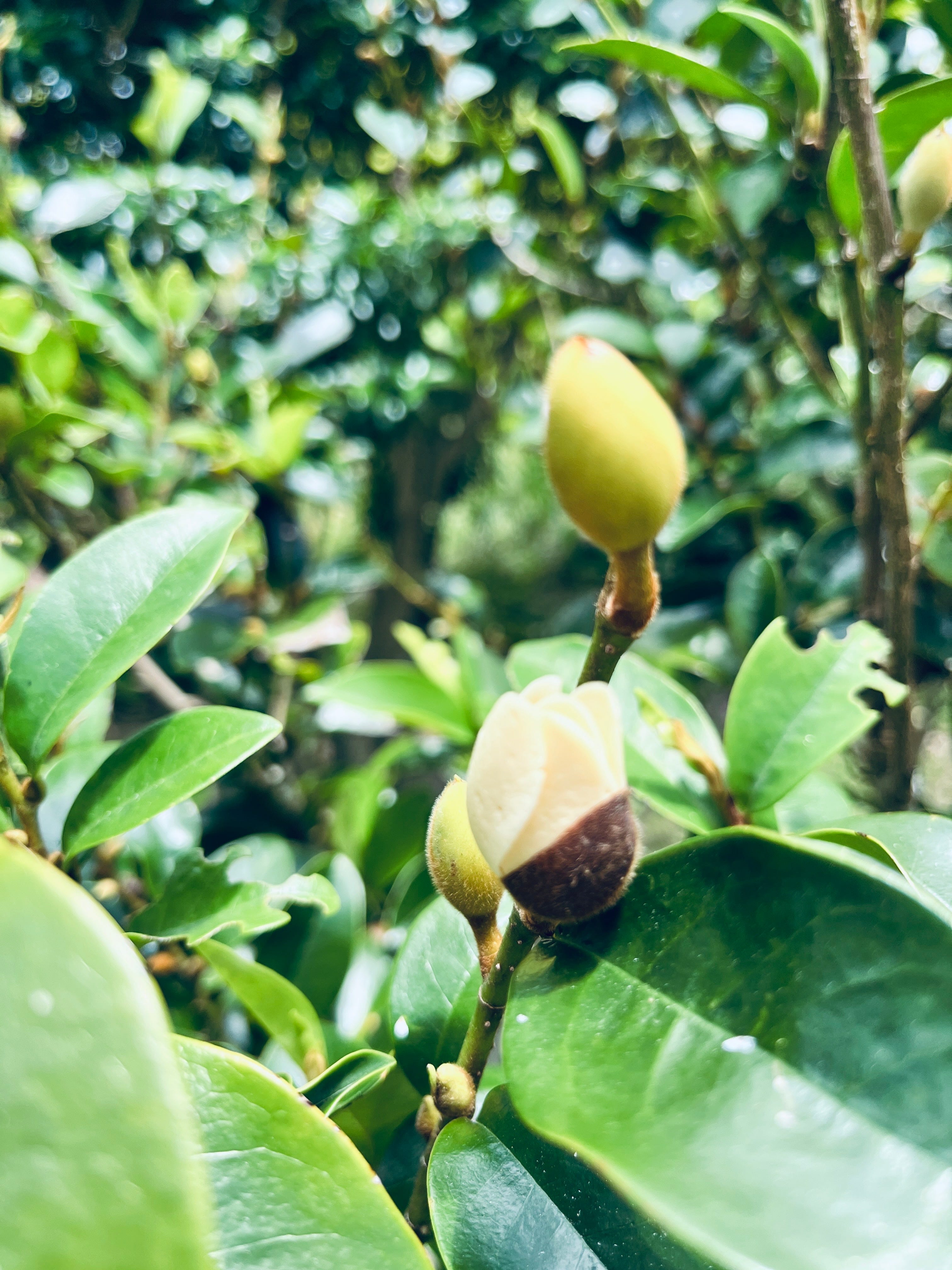
含笑花

含笑花
----------------------------------------------
含蓄矜持的含笑花
是阿嬤一生的寫照
不管喜樂或悲憂都含笑不語
這是有勞苦沒怨聲的阿嬤
百年後
含笑依舊含笑仰視星宇
而你我已魂各一方
含笑花的花語是「美麗、莊重、含蓄、矜持⋯⋯」等等,你想得到的古代婦女被要求的美德都在裡面,也許也有「守貞守節」吧!妳將得到一座流傳萬世的「貞節牌坊」。
阿嬤家廚房後面,在汲水井和一排竹林之間,種著一棵鬚根已緊緊跟地面相連的老榕樹,還有幾棵含笑花和玉蘭花。記憶中的阿嬤,在花開時節,每天晨起總要在梳妝挽起髮髻後,慎重地在髮簪旁配上一朵含蓄莊重的含笑花,或者淡雅高貴的白玉蘭。喔,原來阿嬤是這樣的期許自己的,不管喜樂或悲憂,都含笑不語。真的,外婆總是簡約持家,有勞苦沒怨聲,印象中也沒什麼話語,有的話就是噓寒問暖,關心兒孫是否吃飽穿暖,或者稍稍大聲一點把在大太陽下玩樂的孫們喚進屋裡,再一一擦去滿臉滿身的汗水。記憶中,沒有外婆的笑聲,有的只是微微一笑,有時會摀起難得較為燦然的笑容,抑或轉身而笑。
含蓄矜持的含笑花,就是阿嬤一生的寫照。
花開時,晨昏沁入心扉的香氣甚是濃郁,微微張開的花瓣,猶如含羞輕笑不語的少女,因此漢語稱其為「含笑花」。盛開時,沁入心扉香氣的甚是濃郁,特別是在晨昏,滿園濃濃的醇果香,而最為明顯的是香蕉的香氣,因此英文以「Banana Shrub」稱之。不管是以其形或就其香命名,都有著人類單純的直覺,感知到的是親切而沒有時空的距離。百年後,含笑依舊含笑仰視星宇,而你我已魂各一方,不是嗎?
原產中國南方的含笑花,被稱為「南國名花」,有著「向人無語長含笑」的矜持,這樣的特質吸引了文人墨客,或詩或文,或寄情、或詠嘆、或自憐⋯⋯。以下分享一首台灣詩人吳望蘇(1868-19320的詠含笑花,
「含香蓄氣本天然,笑臉微開別樣鮮。意欲有言難啟口,春風庭畔一嫣然。」
含笑花雖全年開花,但以春天至初夏開得最為繁盛,進入盛夏時花雖盡落,但枝葉仍然翠綠硬挺,新芽不絕,來春的滿園花香當可期!
Michelia Fig (Banana Shrub)
⋯⋯⋯⋯⋯⋯⋯⋯⋯⋯⋯⋯⋯⋯⋯⋯⋯⋯⸻
The reserved and modest Michelia figo—the “Banana Shrub”—
is the portrait of Ama’s life.
Whether in joy or sorrow, Ama smiled in silence.
She labored without complaint,
enduring hardship without bitterness.
A hundred years later,
the Michelia still blooms, smiling upward toward the stars—
while you and I are but souls scattered to different realms.
⋯⋯⋯⋯⋯⋯⋯⋯⋯⋯⋯⋯⋯⋯⋯⋯⋯⋯⸻
The flower language of Michelia figo speaks of “beauty, dignity, modesty, reserve…”—all the virtues once demanded of women in ancient times. Perhaps even “chastity and fidelity.” With these, a woman might be awarded a memorial arch to proclaim her virtue through the ages.
Behind Ama’s kitchen, between the water well and a stand of bamboo, there grew a banyan tree whose roots clung tightly to the earth, along with several Michelia figo and magnolia trees. In memory, when the flowers bloomed, Ama would rise at dawn, arrange her hair into a bun, and carefully place by her hairpin a reserved and dignified Michelia blossom, or, at times, a graceful magnolia. This was how Ama held herself: whether in joy or sorrow, she always smiled in silence.
Ama kept a frugal home, working hard without complaint. Her words were few, and always words of care: asking if children had eaten, if they were warmly dressed; calling them in from play under the blazing sun; then wiping the sweat from their faces and bodies. Rarely did Ama laugh aloud. At most, there was a faint smile, or a brighter smile quickly hidden behind her hand, or turned away so no one would see. The modest and reserved Micheliafigo is Ama’s life in full.
When in bloom, its fragrance fills the air, especially at dawn and dusk. The petals, half-parted, resemble a shy maiden smiling without words—hence the Chinese name, “Flower of Hidden Smile” (Hanxiao Hua). When fully open, its fragrance is rich and sweet, like ripe fruit, most distinctly bananas—and so in English, it is called the “Banana Shrub.” Whether named for its form or its scent, both reveal human intuition: a closeness felt beyond time and space. A hundred years later, the Michelia still smiles upward at the stars, while you and I are scattered souls.
Native to southern China, the Michelia figo is honored as a “famous flower of the South.” With its quiet reserve, “smiling without words,” it drew poets and scholars alike to write verses of longing, lament, or self-reflection. Here is one such poem, by the Taiwanese poet Wu Wangsū (1868–1932), in praise of the Michelia:
“Fragrant by nature, its essence stored within,
A smiling face half-open, fresh and fair.
It longs to speak, but words will not arise—
A gentle smile beneath the springtime air.”
Though the Michelia figo flowers year-round, its blossoms are most abundant from spring to early summer. When midsummer comes and the flowers fall, its leaves remain green and firm, sending forth fresh shoots without pause—a promise of another spring, and another garden full of fragrance.
+ Ama means grandmother in Taiwan