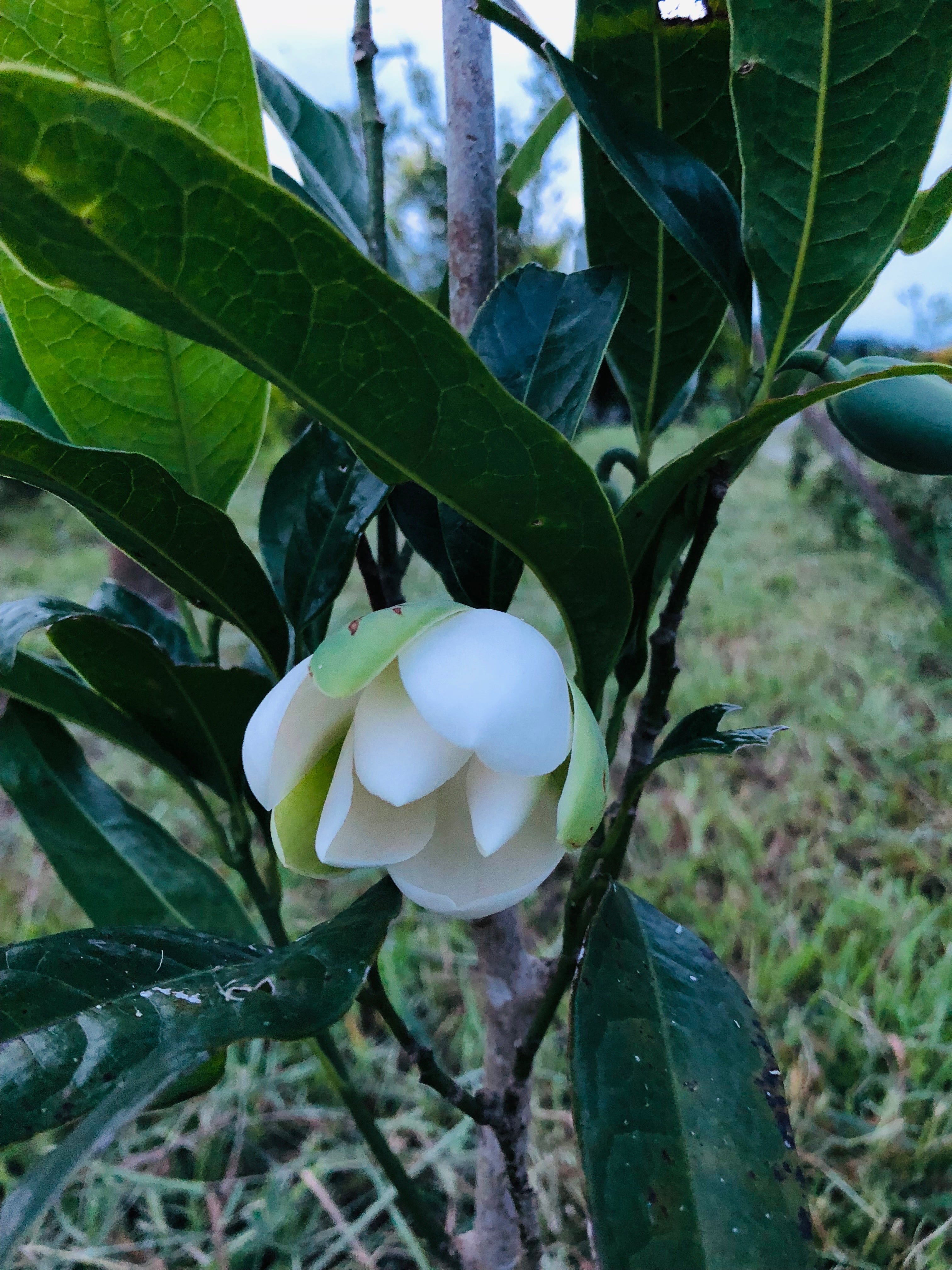
夜合花/Coco Magnolia

Upright and straight body
Not easily opening her mouth to speak a word
Only at the time of evening twilight
Revealing a few hints of subtle fragrance
At twilight, as soon as that familiar faint scent arrives at the window, I know the "Night Close" has bloomed. Actually, "Night Close" does not just have its petals "close" at "night"; during the day she is equally silent, not easily opening her mouth to speak a word.
If we know her English name, Coco Magnolia, we know that belongs to the Magnolia genus, therefore she is also called "Night-Scented Magnolia."
The leaves of this magnolia are a dark green slightly glossy, attached to upright and stiff branches. If there is a wind strong enough to flip the leaves, a powdery white-green flashes amidst the deep green clumps—that is the back of the leaves. The leaf margins are slightly wavy, and the hard, leathery characteristic makes bugs shake their heads and stay away; therefore, all year round, there is no sickness, no pain, and no groaning.
Not long after the axillary flower buds poke their heads out, the flower stalks hang down in the direction of the earth's core. The sepals and bracts number three each, all a green tinged with powdery white. After blooming, one can see the creamy white petals slightly wrapping inward, always reserved like a ball, and the fallen petals resemble handleless spoons.
There are three trees in the garden that came from a good friend's recommendation; the reason for the recommendation was that the flowers are very fragrant. However, after personally participating in the process of blooming and withering, I discovered that after being held captive by her fragrance, my heart also surrendered because of her gentle flower shape and the delicate, smooth touch of the petals. Thus, my heart settled and settled during the countless nights keeping watch over her...
Although the Coco Magnolia's main blooming season is summer, growing in the mountain village, they seem to be somewhat of an exception, often inadvertently emitting a fragrance that surprises you, regardless of the season. This likely has to do with the climate of the mountain village, because in warm regions she will bloom all year round; for this year's "warm autumn," they will not be absent.
Formosa, one of her places of origin, is a place they happily reside. Solitary plantings in small gardens, clusters in parks, lining the roadside facing the wind—they all equally, in a low-key manner, hide their flowers under the leaves, until revealing a dot of faint white and a few hints of subtle fragrance.
夜合花
─────────────
直立挺直的株身
不輕易開口說一句話
只在晚暮時分
透出幾許暗香
傍晚時分,只要那熟悉的微香來到窗口,就知道「夜合」開花了。其實「夜合」不只「夜」間花瓣「合」上,白天也一樣靜默,不容易開口說一句話。
如果我們知道她的英文名Coco Magnolia,就知道那是「木蘭屬」了,因此又被稱為「夜香木蘭」。
這種木蘭的葉片是深綠色中略帶光澤,依附在直立硬挺的枝條上,若有足以翻掀葉片的風,在深綠叢中就閃著粉白的綠,那是葉子的背面。葉緣微呈波浪狀,硬革質的特色,讓蟲蟲搖頭遠離,因此一年到頭都無病無痛無唉聲。
腋生的花苞探出頭不久,花梗就往地心的方向垂下,萼片苞片各三,都是帶點粉白的綠,綻開後可見乳白色微往內包的花瓣,總是含蓄地如同一個球,而飄落的瓣片又如同無柄的湯匙。
園中有三棵是來自好友的推薦,推薦的理由是花很香。然而在親自參與花開花謝的過程後,發現被她的香俘虜後,心也因著她溫婉的花形,以及花瓣細緻滑順的觸感而失守,於是心在無數守著她的夜晚沈澱沈澱⋯⋯
雖然夜合的主要開花季節是夏季,但長在山村的她們,似乎有些例外,常在無意間散發讓你驚喜的芳香,不分季節。這跟山村的風候應有關係吧,因為在溫暖地區她是會全年開花的,今年的「暖秋」她們是不會缺席的。
原產地之一的福爾摩沙是她們歡喜居住之地。小園中的單植、公園裡的叢聚、路邊的列隊迎風,她們都一樣低調地把花隱藏在葉下,直到透出的一點微白幾許淡香。